
Y
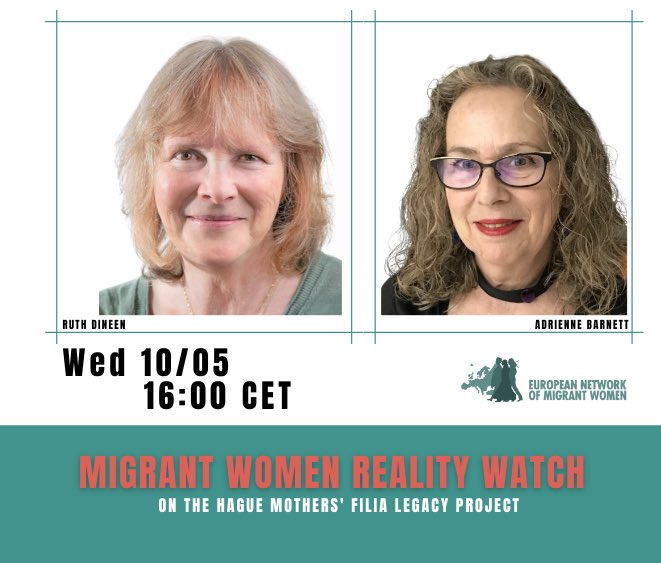
Migrant Women Reality Watch
The European Network of Migrant Women (ENoMW) invited us to talk about the Hague Mothers’ legacy project as part of their Migrant Women Reality Watch series. They have been running a month-long communications campaign during May linked to an EU-funded ‘Mums at Work’ project which aims to strengthen migrant mothers’ labour integration and to raise awareness of their rights.
Ruth, who is co-ordinating the Hague Mother’s project, was joined by one of our UK participants, Adrienne Barnett of Brunel University, London. Adrienne practised as a barrister in London for over 30 years, for 25 of which she specialised in Family Law, including Hague Convention cases. She has collaborated with international practitioners and scholars to seek improvements to the way in which courts respond to victim/survivors of domestic abuse in Hague Convention cases. Adrienne is a member of the Advisory Group of Rights of Women and the Expert Advisory Group to Women’s Aid’s ‘Child First’ campaign.
Many thanks to Adrienne for her expert contribution.
And to Adriana of ENoMU for the invitation and for your organisations’ support for the Hague Mothers’ legacy project. We appreciate it!

Resistance is Futile
“On the current operation of the law, once a woman conceives a child, regardless of the father’s subsequent level of involvement or conduct, she has unwittingly traded her right to liberty of movement and the freedom to choose her own place of residence if she wants to retain custody of her child. The Australian High Court has reaffirmed that, within this patriarchal legal system, resistance is futile.”
Anna Kerr is the Founder and Principal of the Feminist Legal Clinic in Sydney, and is working with us on the Hague Mothers’ legacy project. The Feminist Legal Clinic works to advance the cause of feminism and champion the human rights of women and girls by providing legal support to feminist organisations, groups and services and the women who access them. It is in that pro-bono role that Anna first became aware of the Hague Convention, and of the rigidity and lack of humanity of the court process.
She wrote this article in 2018. The situation has not improved in the intervening time.
(The article has been reproduced with the kind permission of the ALA. For more information about the ALA, please go to: www.lawyersalliance.com.au.)
The Women Lost Everything: The Hague Convention in Australia
Lawyer and academic Gina Masterton became an activist when her sister had a Hague case brought against her. That story has a (rare) happy ending but Gina continues to campaign to get the Convention amended. In this episode, she talks about the harshness of the Australian courts and the extent to which the convention is failing both mothers and their children.
Listen here (transcript below):
Transcript:
Ruth: Hello, this is Ruth with the fourth in our Hague Mothers series of podcasts. The Hague Mothers’ project is intended to raise awareness about the impact of The Hague Convention legislation on mothers and on their children.
Over 100 countries have signed up to the Convention, including the UK, the USA and Australia. The latter is known for its particularly narrow interpretation of the law and its disinclination to consider the circumstances which might lead to a mother fleeing across international borders with her children. But to be fair, it’s not alone in this.
To find out more about the Australian context, I’m absolutely delighted to be talking with Gina Hope Masterton who is working with us on The Hague Mothers’ project. Welcome Gina.
Gina: Hi Ruth. And thank you for inviting me to be a part of this podcast.
Ruth: An absolute pleasure. So a little bit about Gina.
She trained as a barrister. She’s currently a post-doctoral researcher at the Queensland University of Technology in Brisbane. Her research involves looking at transportation justice for indigenous women in Australia who are domestic violence victims, and identifying obstacles to justice.
Both Gina’s Masters and her PhD were focused on The Hague Convention and its effects on women and children. And she is absolutely passionate about righting the wrongs of this legislation. In a recent email to me, she wrote:
‘No law, which abuses women and children should be left unchallenged. I will do whatever is in my power to get this Convention amended. It should have happened decades ago.’
We agree Gina. And if this wasn’t a podcast, you’d see me punching the air! Could you tell us how you came to be interested in The Hague? What drives you?
Gina: In 2013, my own sister, Rebecca was ‘Hagued’ – that’s what I call it when women go through the Hague legal process and come out the other end like they’d been in is a washing machine and, you know, they’re left kind of wondering what happened.
So she was Hagued by the Australian family court actually. She’d been married to an American citizen for a couple of years and had a child. However, after secretly suffering years of domestic violence perpetrated by her child’s father, she fled back to Australia – which is her home country – with her infant child.
Her husband then used the Convention against her and filed a Hague return application with the Australian government. And without knowing anything about him or the circumstances around why my sister fled, the Australian family court ordered her to return her child to the USA – in effect to her abusive husband. I’d been a lawyer for about 13 years at that time. And I’d never even heard of The Hague Convention until my sister got persecuted under this law.
Ruth: I think that’s a common experience. We’ve been talking to lots of people – to lawyers, to academics, to domestic violence professionals, to Hague mothers, themselves – and very few of them have ever heard of the Convention until they’re caught up in it. As you said, it’s like being put through a washing machine and wrung out and you come out the other end thinking: what just happened?
I know we’re going to hear from your sister, Rebecca, in a future podcast because you’re going to interview her for this Hague Mothers’ project. So, this is personal as well as professional.
Gina: It is. When I found out just how far the tentacles of this Convention reach and the absolute devastation it can wreck on women, and their children, I will continue to work to make it a better law for women.
Ruth: I’ve suggested that Australian courts are particularly rigid in their approach to the Hague. Do you think this is a fair assessment, Gina?
Gina: Yes, I do. Ever since the Convention came into force in Australia on the 1st of January 1987, it’s been applied strictly in all cases, even in cases where domestic violence is raised. It’s still very strictly applied by the family law courts.
I did my Masters on The Hague Convention itself and its background and the way it operates. And I came across a case from 2008 called Papastavrou and it involved a Greek woman, who was living in Greece with her husband, but I think she had Australian citizenship as well, and he’d been violent to her for several years.
She fled to Australia – where she had family – with her child, her son, he was also autistic. She just had to get away from her husband because the abuse was ongoing, and she went through a Hague case here in Australia.
And it was one of very few cases where I’ve seen the ‘grave risk of harm’ defence exception raised and been successful. It was only because she had suffered such extreme physical abuse, resulting in brain damage where she was having seizures and she had vertigo, that the family court said something along the lines of, they wouldn’t normally allow domestic violence to satisfy the grave risk exception. However, in this case, the woman was so badly affected that they upheld her grave risk of harm exception.
And that’s a very high bar set by the Australian family court that, if you can show you’re brain damaged from physical abuse, then we may consider this grave risk of harm argument that you’re making. I haven’t seen any other case since then, and that was 2008. So it was quite a while ago. It’s not like that set a precedent; evidence of domestic violence has not been allowed to satisfy the grave risk of harm exception.
Ruth: So even that high bar is not being followed through in any way?
Gina: No. I sat in on another case a couple of years ago in Brisbane and the mother was from a South American country and her husband was running a drug cartel. She had clear evidence from the courts there, that he was a violent criminal. She had domestic violence orders against him. He was 10 or 15 years older than her, sort of coercive control and threats, threats to kill her family.
And yet, the Brisbane family court ordered her to return her five-year-old son to that country. And she went with the son and apparently went into hiding and I never heard from her again. I hope that they’ve been safe ever since then.
This is the type of thing. You can come with boxes of evidence of showing that if you return, if your child’s returned, that physical harm could occur and yet the courts will be so reluctant to not make a return order. I was just flabbergasted after that case. I didn’t know what you had to do to be able to have a finding made in your favour.
Ruth: I know that in Australia, as elsewhere, concerns about the injustices perpetrated by The Hague Convention are regularly being raised – obviously by you, but also by other lawyers and academics. And even by Diana Bryant, the former Chief Justice of the Family Court, and indeed The Hague itself. I’m just wondering if any of this has changed anything.
Gina: I respect Diana Bryant a lot. She was the former Chief Justice of the Family Court and she was part of the HCCH committee that looked at this back in 2017 and put out another guide to domestic violence related cases. That was the first time they actually acknowledged this as an issue, as a problem. It’s a growing problem.
But they didn’t take that opportunity to go, look we’re really going to make a change here; we’re going to amend it, or we’re going to tell signatory countries that they should look at their own laws and add some kind of domestic violence defences into their laws so that these cases are handled differently.
They just put out another guide which said to judges ‘do what you think is right’. And that’s not really telling judges that this is an important issue and they really need to look at the facts of domestic violence related Hague cases. So that was a wasted opportunity and I was very disappointed. The only good thing was that the HCCH acknowledged that domestic violence related Hague cases are growing in number. But nothing really changed here.
Ruth: I’m really interested in your approach of going through stories; getting to the real human heart of the matter rather than simply staying at the legal level. Some of those stories I’m sure have been profound in their impact on you. Do you want to give us some examples of women who’ve tried to flee with their children and been sent back?
Gina: Well, what I found with the ten women I interviewed was they all had tried to access help in their countries with the authorities there before any notion of leaving occurred to them. They got domestic violence protection orders; they sought legal advice; they went to doctors and psychologists. They tried to get the help they could through the available resources they had until it came to a point – some of these women were abused for years – and then it came to a point when it really started affecting their children. That was when they realised they had to get out of it some way, they had to put physical distance between themselves and their abusers.
So it was roundabout when their children became school age that there was this pattern where the women would finally decide that they had to physically remove themselves and their children from this toxic environment.
Nine out of the ten women had professional or academic qualifications, they were running businesses or working in professional jobs. They were intelligent and accomplished women who just ended up finding themselves in a situation with their partners becoming abusive and it gradually getting worse over time. They had tried to utilise the system to protect themselves and their children before eventually leaving.
But then when they do leave and they’re in a situation where they’re going through The Hague process, particularly in Australia, I found that the judges here were very harsh. They were very judgemental, they took it very personally. It wasn’t just an administrative type matter, which The Hague is – it’s administrative, it’s civil, it’s not criminal – but the judges here really did treat the women like they were child abductors, that they had done something criminal, and the women felt that way too.
It’s just devastating. They lost everything. They lost their homes, they lost their incomes, they lost their careers, they lost most of their personal affects, they lost relationships, they pretty much lost everything. And some of them even lost contact with their children. Some of them lost their liberty, some were threatened with going to jail if they didn’t cooperate with the authorities.
So there’s a lot on the line when you cross an international border with your child. These decisions are not made lightly. But judges don’t seem to take that into account in Australia. They just look at you as a woman depriving a father of time with their children, which is a very narrow view to take.
Ruth: Yes, it is indeed. So have there been any successes in terms of the women you interviewed actually managing to not return with their children?
Gina: No. They all had to return. [The courts] don’t order the mother to return. They can’t do that. They order the child to be returned and then the mothers go with the children because they want to, they choose to. Once they do they have to then deal with the domestic family court in their jurisdiction, to deal with child custody issues and parenting issues.
In some cases, the fathers have already gone to court and gotten full custody of the child while the mother was in the other country – in her absence they managed to go to court and get orders giving them full custody of the child. So once the mother comes back with the child, the father’s allowed to swoop in and take the child. If the mother doesn’t go to jail that’s a positive, but then she’s left without anything and starting her life over again.
But three of the women that I interviewed got relocation orders – which took a lot of time and a lot of money – allowing them to relocate back to their country with their child, which is what they did in the first place. They had to get returned and then do the relocation application. So it’s a big circle, but three of them got to go back to their home countries with their children.
And what I can say about all of them is, none of them returned to their abusive partner. So that’s a bonus. I was happy for them that they didn’t have to do that. But their lives are forever altered, forever changed and not in a good way. They carry that with them, for the rest of their lives, this whole Hague experience.
Ruth: Absolutely. Yes, it has a profound impact and of course, an impact on the mother has a huge impact on the child, which is the other aspect that The Hague doesn’t seem to take into account, that being parted from your mother, your primary carer, has an impact.
Gina: Absolutely.
Ruth: The more I hear about The Hague, the more I wonder if it’s beyond redemption or if anything can be done to make it a viable piece of legislation, what do you think?
Gina: Well, I think that it works extremely well for the cases that it was designed to deal with, and that is cases involving non-custodial fathers who kidnap their children from their mothers and their homes and take them to other countries. That’s what it was drafted for and I think it works very well for those types of cases.
However, when it’s applied to cases involving abused mothers who are fleeing domestic violence as a last resort with their children, it completely fails. It fails the mothers; it fails the children. It just needs to be amended. It needs to be amended by the HCCH and all it would take is the insertion of a few specific domestic violence related defences added to the Convention.
If it can’t be done there, if it’s too hard, then each signatory country really needs to look at their own Hague law and their own Hague regulations, and add their own domestic violence defences into their own laws because this cannot continue.
When the HCCH in 2017 finally got together and met, it was the 7th meeting of the special commission on the practical operation of The Hague Convention, they acknowledged that domestic violence related cases are a big issue and they’re happening all the time. And yet all that came out of that was yet another book of guidelines. It’s a step in the right direction that they’re acknowledging that this is an issue, however, that’s where it finished. So I think it’s up to each country now to recognise this is a problem and to take steps by amending their own laws to better protect women and children.
Ruth: That’s an interesting approach because the idea of tackling the hundred plus signatories to the Convention all at once is quite an overwhelming idea, but if each country can do something towards this, that might help.
Last question, Gina – and thank you so much for all your input and your expertise and your passion – what do you hope the Hague Mothers’ project might achieve and what made you decide to be part of it?
Gina: Well, I am honoured to be a part of this amazing project with all the amazing women who are putting their hands up to try to make change in this area. And I just really hope that our combined voices and experiences will be heard and understood by those who have the power to end the suffering of women and children who are damaged by the Convention.
I want to continue the fight for this change in recognition of my own sister who went through it, the ten mothers I interviewed for my PhD project, and for all the mothers who are getting Hagued every single day around the world. They don’t appear in the media, there’s no statistics kept, they are just another Hague story not everyone will get to know about.
If we have to battle the patriarchy to get this changed, to make life better for abused women and children, then I feel it’s the least I can do. And as a feminist human rights lawyer, I owe a duty to women who find themselves facing this Convention. And I’ll take every opportunity offered to me to work towards getting the changes made.
Ruth: Thank you so much, you are an inspiration you truly are. I actually came across you several years ago when I met a Hague mother and I was reaching out across the world to try and find out who might help. And I reached out to you and you immediately replied with such warmth and compassion, I thought, this is a woman I want to work with. So it’s fabulous to be working on this together with you. Thank you so much, thank you for taking part in this podcast, and thank you for working on The Hague Mothers’ project with us.
We look forward very much to hearing from some of the women whose voices you’ve had helped amplify in our future podcasts. And I hope we hear from you too, as we progress and hopefully make the changes you suggested.
Gina: Thank you Ruth, and I’m happy to do whatever I can to get this all happening.
Ruth: Wonderful. Thank you Gina.
We need to raise awareness about The Hague Convention. Please help us by sharing this podcast and others in the series. If you have experiences or expertise to contribute, please get in touch with us at FiLiA and, if you can, please come to the Hague Mothers’ session at the FiLiA Conference in Cardiff in October. Thank you for listening.

The Hague Convention & Domestic Violence: Fleeing to Safety – Returned to Abuse
In this episode of the FiLiA podcast, lawyer and activist Sudha Shetty talks to us about the often desperate consequences of The Hague Convention for mothers and their children who are fleeing domestic violence. Her response to this injustice has been inspirational: the Hague Domestic Violence Project which she founded is a beacon of hope which we hope to build on through our international Hague Mothers’ project.
Transcript:
Ruth: Hello and welcome to the third in our series of Hague Mothers podcasts. I’m Ruth and I have the privilege of coordinating this project for FiLiA. In previous podcasts, we talked about the injustices created by The Hague Convention – for mothers and for their children. The issue of domestic violence has been front and centre.
The Convention was originally targeted at fathers who took the children across international borders. It was intended to ensure the swift and safe return of those children to the primary carer – assumed to be the mother.
So the legislation did not consider why a parent might take their child. The Grave Risk or Intolerable Situation defence focuses only on the child. The risk to the mother is of no interest to the court.
To discuss this issue, and the work that’s been done internationally to acknowledge the significance of domestic violence in Hague cases, I’m absolutely delighted to welcome lawyer and activist Sudha Shetty who is working with us on the Hague Mothers’ campaign.
Sudha Shetty: Lovely to be here. Ruth, thank you for inviting me.
Ruth: Sudha is the founder and director of The Hague Domestic Violence Project at UC Berkley. Her research focuses on international child abduction and violence against women. She’s been working with judges, lawyers and academics across the States to create judicial handbooks and to provide training, to help protect women and their children from the abusive consequences of The Hague legislation.
Sudha is also a founding member and Chair of Chaya, a grassroots South Asian domestic violence prevention programme in Seattle. And she’s the recipient of many, many awards, including the Father Drinan Award for forwarding the ethics of pro bono and public service in law schools.
Thank you so much for being here Sudha, and thank you for being part of the project. So if we could start by finding out how you first became involved in The Hague Convention?
Sudha Shetty: That’s very interesting. It’s just one woman. We’ll call her Jane Doe. I was actually at Seattle University Law School at that time and also the Director for the Access to Justice Institute. And my work was really looking at access for people of colour and immigrants into the courts.
And I was doing a lot of domestic violence work, but my work was only focused on immigrant mothers, looking at deportation proceedings, looking at access to the courts, and working with the police on that.
But then this case came across and it was sent by Professor Jeffrey Edleson from the University of Minnesota. He said there is a mother who needs some help. She came to me, reached out to me to be a child expert on her case, but I think you need to meet her.
And in walks Jane Doe and she sits down and she tells me that there is this case and mentioned a petition that has been filed against her. I looked at it and I said, what are you talking about? I’ve never heard that before. And I’ve been doing this work on domestic violence. I pretty much know the ins and outs of domestic violence. So I don’t understand this one. And I said, why don’t you just tell me the story.
She had gotten married to German citizen, moved to Germany. She was a doctor here in the US, practicing doctor, but because of getting married to this gentleman, she moved to Germany and was not able to work because she did not have work authorization. She was living at home, got pregnant and when she was sitting at the doctor’s office for her OBGYN exam, she read a brochure and she saw what was written there about domestic violence and realised that she was actually a victim of domestic violence.
And so she then went to the police station to complain about it. And the police brought her back to him and told him in German ‘watch out, she’s going to be running away, take away her passport’. And so then she realised that she was not going to get any help from the police. So she went to the American embassy and the American embassy against all odds, helped her.
They came, picked her up and her kids, she had two kids by then and took her away. And so she came back to the US to her family, and filed for a dissolution, for a divorce. And the divorce case had already started when this Hague petition was filed against her. And I had no clue, I had never heard of it. Did not know what it meant, did not understand it but I did realize that there are now two countries involved in this issue. She told me that the worst part of it is that the hearing is going to be very quick and her kids might have to go back.
So I told her I needed 24 hours to go through this quickly, to figure out what it is. But in the meantime, I told her, you have to tell your lawyer, who’s doing your dissolution proceedings, that they must put domestic violence in your dissolution proceedings, because if it is in the brief, then we can use that for this case as well. And that is how it all started. This whole project came about because of Jane Doe.
Ruth: That’s an extraordinary story, but I think it’s a frequent one. Often lawyers have never heard of The Hague. And then when they hear it, they say we’re appalled at the injustice and then they get involved. So it’s really what happened with you. I know in our conversations before, we both see this as a feminist issue, particularly in relation to the inequality women face when they come to court. Do you want to tell us a little bit more about that contextualisation?
Sudha Shetty: As you said before, the convention was created because there were fathers taking their kids across international borders. And I totally believe that we need to have protocols in cases like this, but I also think that the convention did not think of the unintended consequences of this treaty. Essentially now more than 60% of the taking parents are mothers. And the mothers are only fleeing because they want to protect themselves and their children from domestic violence. They realise that the country they’re in is not giving them the protection that they need. And they have tried everything and it has not worked.
The only solution they have is to take the children away – and they do know the consequences they’re going to face when they take the children and go across international borders. But you know, for these women it’s either that, or they will lose their life or they might lose a child. They have no choice and they have no one to turn to. This is the only choice that they have. These women then end up being in a country where they might have no work authorisation, have no resources, do not know how the law works, do not have anybody to help them. In some cases, they may move to family, but in some cases they may not, and then suddenly they have a petition filed against them.
And you have somebody who now is struggling to find a lawyer, doesn’t know the law and they find the lawyer who doesn’t have a clue. So now they’re trying to educate the lawyer, the lawyer is not trying to figure out how do we work on this. They get nothing, no help from anybody whatsoever. They don’t have the finances.
So really for women, it’s like 10 strikes against them. First, you have a strike for being a woman. Then you will get another strike, for being with a man who’s battering you. And then you have 25 more strikes when this [a Hague petition] happens to you. It’s a huge disadvantage.
Ruth: It is, isn’t it? And I know that you’ve done a lot of work with immigrant women, where there are even further disadvantages that pertain to them. So do you feel that the whole approach that’s being taken to The Hague at the moment actually acknowledges that in the courts?
Sudha Shetty: No, because The Hague’s primary responsibility is to send the children back to their residence, habitual residence that they came from and then custody decisions are to be made in that country. So they do not look at any of those things.
What we are trying to say, or what I’m trying to say is that when court makes a decision to send the kids back, they essentially made a custody decision because when the child goes back, the courts there think, oh, you know, that foreign court has sent the kids back that means the kids are meant to stay here.
And more often than not, the mother also has a kidnapping charge filed against her for taking the child. So most mothers go with the children. So the moment she steps onto the soil of that country, she’s taken away for kidnapping charges. She’s in jail. He takes the kids to court and says, there’s nobody to take care of the kids. So he ends up getting custody of the kids.
Most people don’t understand that no matter how educated you are and how much finances you might have at home, but when you take your kids and you go away, you have nothing left, it is pretty much starting from scratch. And so it’s a devastating thing for women because all they’re trying to do is protect the children and themselves, that’s it, that’s all they’re asking for. They’re not asking for anything more. They’re just saying. I just want to make sure my kids are safe and I am safe.
Ruth: Yes, absolutely. I first heard of you through The Hague Domestic Violence project, which is an extraordinary beacon of good practice in this very damaging area. Would you like to tell us a little bit about how that project came into being, and indeed what you feel achieved?
Sudha Shetty: Well, Jane Doe walked in, I had 24 hours to figure out what this was. I read up everything. And then I realised, oh my God, this is a systems problem. We’ve got to change this bloody system; we’ve got to change the treaty.
So I went to my librarian, the law school, and I said, ‘look we’ve got to change this treaty’ and he goes through it and everything. And he says, give me 15 minutes, come back in 15 minutes, I come back in 15 minutes and he says, Have you read this there are 72 countries (at that time, there were 72 countries that had signed up)? Every one of those 72 countries has to agree to what you have to say, and then they have to sign up. You think any of them are going to listen to you? Who do you think you are?
And I realised, oh, yes, that is a problem. Because the majority of the countries do not even have human rights laws, forget addressing violence against women.
So the next step I have to do is look at it for the US so if it is for the US I need to first find out and educate lawyers. I have to educate moms, these mothers have no clue – they know about The Hague but they don’t know what they need to prepare in order for that. And then I need to educate judges because the cases just come in front of them and sometimes it’s just that one only case that might come in front of them because we don’t have a special bench [in the USA].
England has a special Hague bench. Australia does. US doesn’t, so it’s federal and state courts. It could be any of the courts the case would go – lots of these cases go to small state courts. When The Hague petition is filed and the left-behind parent comes to the US, they have the Office of Child Support who give him a whole stack of information, give him help, give him an assistant, and she has nothing.
And so I thought, okay, I’ve got to help create something for judges. So immediately I put out a call for students to volunteer. I got 70 volunteers.
Then I decided I’ve got to have LexisNexis and Westlaw who are beacons that help collect all the cases, all the information. I got them on board, they gave us every help possible. They even created a huge theatre for us, so that everybody would know about the stories of the women; we created a vignette and a play out of it, helped by Westlaw.
And then I started working with different states, getting Supreme Court judges of each state to chair committees and create bench guides for judges.
Then I decided I needed a lawyers’ practitioners’ guide. We would get lawyers calling us and saying, what do we do? How do we do this case? I wanted to make sure that we put all the social science of domestic violence into it because there are certain exceptions [available as defences in Hague cases]. And I wanted to make sure that we used the Grave Risk exception for domestic violence.
And so that’s how the project got started. And I then realised that in order for me to really make it known, I needed to have enough information on it. I needed to have research, then people would believe me. Otherwise they would be like, oh yeah, sure. There’s one case here, one case there, what do we care? It’s not a big deal.
So then I started knocking on the door of the National Institute of Justice and kept talking to every program officer and telling them why it was important. I kept hanging out in Washington DC. I would go there twice a month at least, knock on doors, talk to them. Finally, they agreed and asked us to apply for a grant. We did. We got it.
I got Professor Edleson from University of Minnesota and Professor Taryn Lindhorst from the University of Washington to partner together to do the research. So they started the research, they wrote a book, it got an award. [Battered Women, their Children, and International Law, NUP, 2012]
And then the Violence Against Women Office said, we are going to put money in and create a funding stream for people who want to actually work with the courts. So that’s how we got a grant – we actually became part of the funding stream. So we’ve made some of those changes. The paper that we’re writing, Dr Edleson and I, lays down the whole history.
Ruth: That is an extraordinary story. The idea, at the heart of it, of making sure that Grave Risk exception included domestic violence. How successful do you feel you’ve been in that key issue?
Sudha Shetty: Most lawyers actually don’t know how to put that in. So it was very important to start educating lawyers, because if they know that can be used, they will. Because when you look at the treaty and you look at what it lays out, essentially, it does not say anything about domestic violence, so most lawyers don’t even think about that.
And ‘grave risk’ essentially has been thought of like it would be now in Ukraine, bombs are falling and that’s a grave risk, you can’t send the child back there. But they never thought anything about sending a child back to a home where there was an enormous amount of violence. Children are exposed to it, even if they are not in the room, they can hear it. Children can sense the danger that is coming in when the door opens and he walks in.
So the most important thing is that I needed to educate judges and lawyers. And so I started doing the circuit in the US, training lawyers through the ABA, through all the different institutes that are there. I started to go into the judicial training avenues and started educating judges on this issue and why it’s important. We need to add that.
Working with Jeffrey Edleson has really been wonderful because he brought that piece, the social sciences piece, and I bring the law and the activism. That has really helped us to actually put domestic violence in the forefront to be used as Grave Risk. It’s being used, but I still think it needs to be done more often. And I think the more we talk about it and the more we say that it’s important and if lawyers start to use it, then judges start to see it. I think it will make an impact.
Ruth: It’s a powerful combination – as you say, the law and the social sciences with the evidence base. Wonderful. So has this work had an impact beyond the States?
Sudha Shetty: Yes. I used to get calls all the time. Australia has called us a couple of times, some of the folks there, because of the work; New Zealand has called us. In Singapore, the Justice of the Supreme Court took our bench guides to create one for the Singapore court so that the judges would have that information.
We also worked with Japan. Japan was getting pressure from the US to sign the treaty because there were all these left-behind parents, fathers who organised and were putting pressure on the American embassy in Japan to make sure that Japan signs the treaty.
So for a whole year before they signed the treaty, Japan sent groups of lawyers to meet with us, to talk about it. And Japan never had family law before. So now they had to rethink and create a family law system if they sign this treaty. And we talked to them about some of the problems. Every country when they signed on, they have to then create implementing legislation in their country – how the cases will be heard in court.
And so we told Japan that one of the issues that the US had is that we did not put more protections for women; that there was no language for domestic violence; and that there was no financial support for the mother at all. And these were three critical things that were needed in the implementing legislation. So they have actually done really well. Their’s is one of the best legislations.
Now I’m helping India. It’s now with the Punjab High Court. India has a group of incredible mothers who fled back with their children because of domestic violence. They are very organised and they put pressure to the ministry to say to the Women and Children’s Ministry not to sign the treaty. So it is now with the Punjab high court. And I told them that Japan uses the best language, that they should just use the language that Japan has.
And so my hope is that the new treaty that gets signed will create implementing legislation that will match Japan’s and that will give some teeth for domestic violence to be entered into the courts.
Ruth: Fantastic. So good to know that there are signs for optimism in this arena. Given all you’ve achieved, and all you’re still doing, we were thrilled when you said you would be part of this project. Can you tell us why you said yes, and what you hope this project will achieve, that you couldn’t achieve in your own right?
Sudha Shetty: I think we need to be more organised in each country because I’m only looking at cases that came into the US, while you are in England, in Wales, and you’ll only look at cases that come into your country.
So you generally do not follow the cases that go out of your country. You follow the cases that come in your country. And so you’re trying to create resources within your country to for mothers that come in there. I think that if we were all organized, we could all make sure that the resources that we put into place are very similar everywhere, so that if a woman from England is coming to the US, she knows that it will be similar and that advocates there can work with her.
The other thing that we had great difficulty with, these mothers flee like that [clicks fingers]. They’ve been planning in their mind, planning in their mind, then when the moment comes, they’re out. They can’t take anything because it raises suspicions. So they flee with nothing.
So often we don’t have enough material about the domestic violence. All we have is her anecdotal stories. And so if she has gone to a doctor because she received wounds, or to the police, we don’t have any of those reports, and she dare not get them because she’d be afraid that it might trigger back to him. So she doesn’t get them.
So one is to make sure that these women who are thinking of leaving, that they bring the information with them, or that the advocate in that country is already known so that they can then provide the information quickly, because the case works so fast we don’t have time for that.
We also found that every case, if they had an expert testimony of the children who witness violence, somebody who comes in and talks about it and the impact and the psychological damage that it does to kids, actually would help in her favour.
We have to make sure that consistently in these cases that they do have such an expert, and that this expert understands to tie domestic violence and the psychological abuse and the impact together. Most of the time, they don’t tie that in. So, I think by us working in different countries together and understanding all of these things, we can then assist the lawyers in each of our countries in how to prepare for these cases.
I’m hoping that we can then actually be able to […] we cannot guarantee anything, but at least we can tell the mother – we’re here to support you and we will do everything we can to help you. And you’re not alone. And that I think is the biggest message that we need to give – that we are all coordinated and we’re all there to support her because she’s often alone.
Ruth: That is a powerful way of ending. She’s not alone. Thank you so much Sudha. Thank you for being part of this project, and for the podcast. And we’ll be hearing lots more from Sudha in the future.
Sudha Shetty: Thank you so much.
Hague Mothers: Flight. Return. Silence.
Today, our Hague Mothers website goes live, a focal point for an international campaign that aims to end the injustices created by The Hague Convention, specifically for mothers and children who are fleeing abusive relationships.
We have already begun to mobilise an international network of women, initially focusing on the UK, USA, and Australia. Lawyers, academics, domestic violence professionals, child psychologists, feminist groups, advocates, journalists, and Hague mothers, are contributing their time and expertise to co-design the project and build an international movement for justice.
Over the next five years, we intend to raise awareness of the Convention, among mothers who are at risk of having a Hague case brought against them, or who are facing a court hearing, and among the organisations and professionals who support them.
We’ll collate an open-access repository of good practice and key resources, and work with others to create new resources where these are needed.
High-quality domestic-violence training and guidance for judges, lawyers, and court officials, is already available in a number of jurisdictions, but it’s not obligatory. We will work to extend availability and take-up.
Where domestic violence or coercive control is involved, we hope to strengthen the exceptions to the otherwise obligatory return of children to their country of habitual residence, particularly where Article 13b (grave risk or intolerable situation) is cited as a defence.
And ultimately we hope to persuade the Hague Conference to amend the Convention in order to ensure that domestic violence is properly addressed in all cases and that its impact on the child – along with the impact of potential loss of contact with the primary carer – is fully recognised within the treaty itself.
Amplifying the voices of women – particularly those less often heard or purposefully silenced is at the heart of FiLiA’s mission, and at the heart of the Hague Mothers’ project.
There is a growing body of evidence that attests to the profound effect of domestic violence and coercive control on children, and a plethora of anecdotal evidence from mothers who have returned with their children following a Hague order. However, there is currently little formal research in to the ‘what happens next’ aftermath of a Hague judgment. Once the decision to return the child is taken, the courts have done their job. As one lawyer put it: ‘judges are not interested in justice; they just apply the law’.
A key part of the Hague Mothers’ legacy project will therefore be to create an archive of mothers’ stories – a permanent record of the often catastrophic impact of the Hague Convention on mothers and their children. We are also collating existing stories from across the world in order to ensure that mothers’ voices are not lost to history.
One of the most recent, and powerful, accounts of mothers’ experience of the Hague is Flight, Return, Silence, produced by Angela Rangecroft for Radio 4. Three mothers are interviewed. Two of them – Kim Fawcett and Anita Gera – are working with us on the Hague Mothers’ project. We are grateful for their courage and their contribution.
#Justice4HagueMothers #SolidarityWithHagueMothers #HagueMothers